After examining the wreckage from downed Russian fighter aircraft, a report by an investigative NGO suggests that the Kremlin is still using foreign-sourced electronics for its military aviation, despite Western sanctions.
The research illustrated the hypothetical effectiveness of Western sanctions, while underscoring how current efforts have largely failed to disrupt supply chains.
JOIN US ON TELEGRAM
Follow our coverage of the war on the @Kyivpost_official.
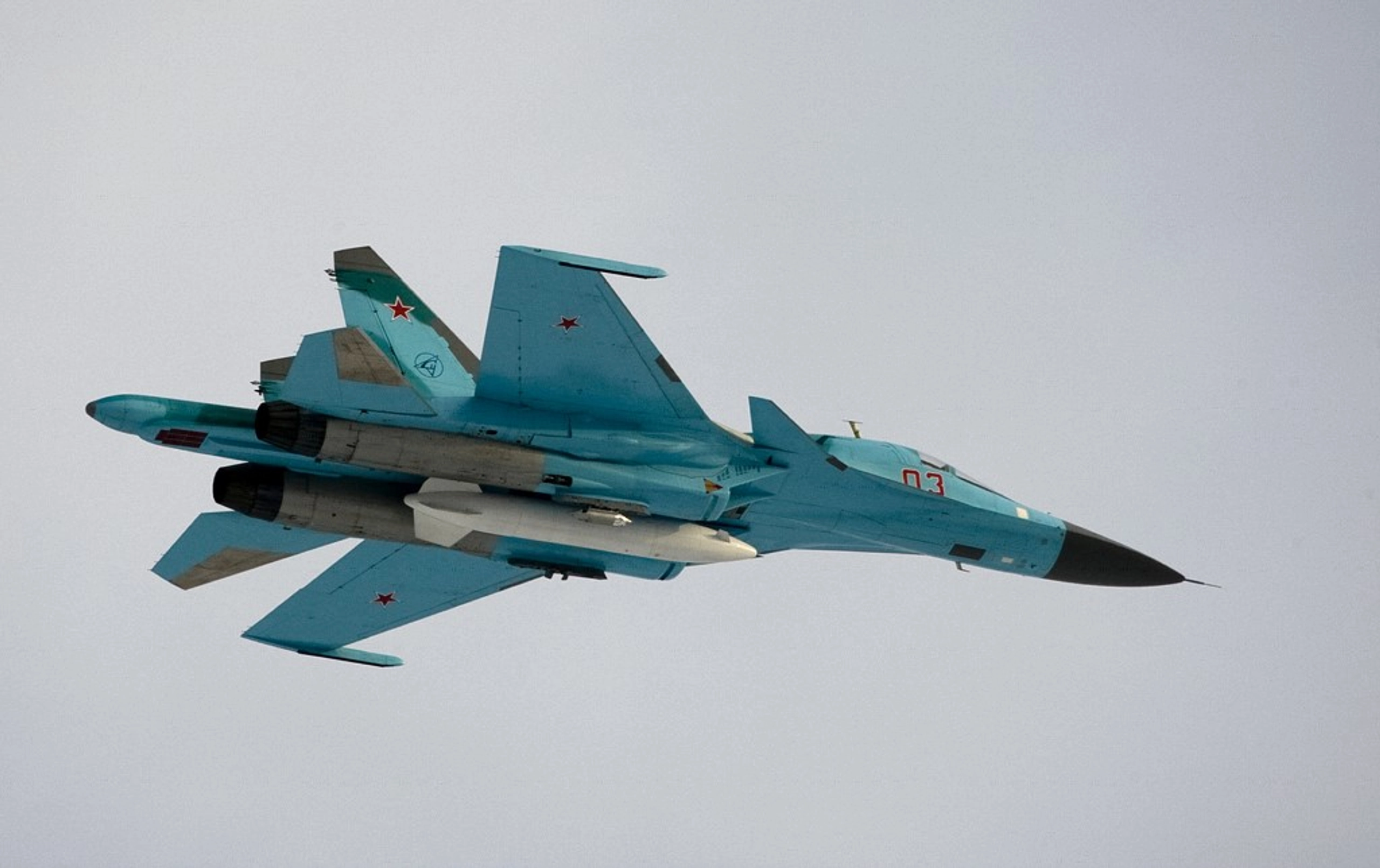
The paper, penned by the International Partnership for Human Rights (IPHR), examined the wreckage of downed Russian Su-34 (NATO: Fullback) fighter-bombers and Su-35S (NATO: Flanker-E/M) air superiority fighters with the help of the Ukrainian Independent Anti-Corruption Commission (NAKO), an NGO.
Where do the components come from?
The IPHR research was able to trace the origin of 1,115 out of 1,119 recovered foreign electronic components from the aircraft.
The identified parts came from 141 companies across the globe – the majority based in the US, with others located in Germany, Japan, Taiwan, and South Korea.
“The list of key manufacturers includes leading microelectronics producers, such as Analog Devices, Texas Instruments, Murata, Maxim, OnSemi, Intel, and Vicor,” it says.
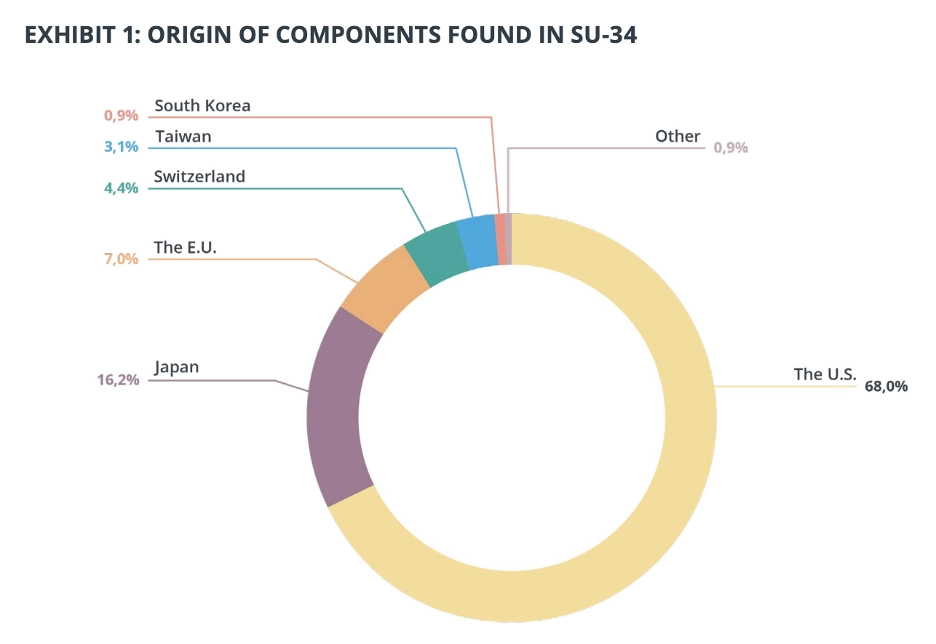
The 221 foreign components found in Su-34s came from 59 companies in eight countries, mainly from the US, followed by Japan, the EU, then Switzerland, Taiwan, and South Korea.
Germany Warns of Russian Orbital Nuclear Threat
In contrast, a significantly larger number of components were traced on the Su-35S air superiority fighters – 889 components from 138 companies. Most components also came from the US, with some, albeit in a small percentage, coming from China.
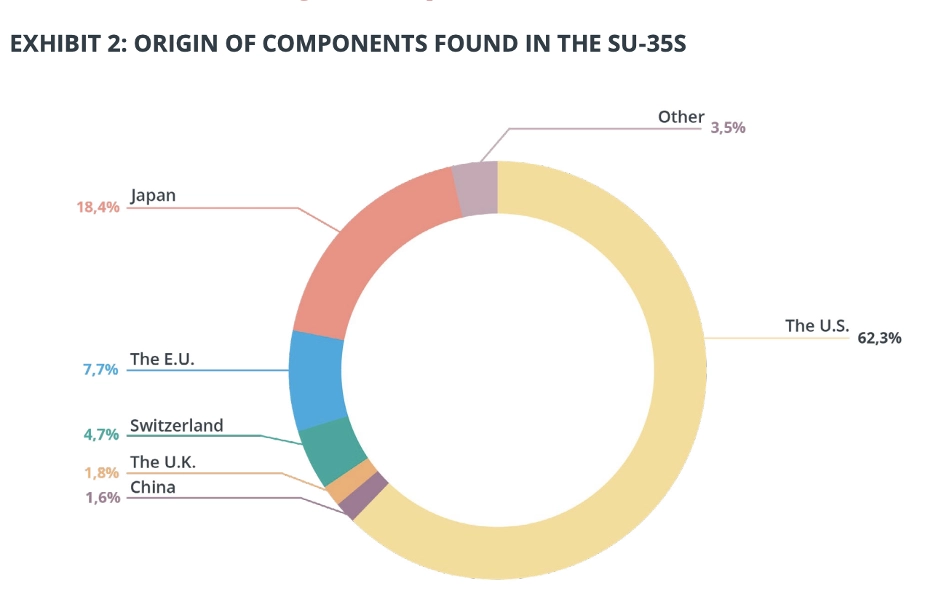
“Although the United States is also the leading supplier of foreign components found in this aircraft, compared to the SU-34, the components found in the SU-35S originate from a wider range of countries,” the report states.
Other identified components came from companies across Asia – including Japan, Taiwan, South Korea, China, Kyrgyzstan and Israel – and Europe, including Germany, France, the Netherlands, Switzerland, the UK, Bulgaria, and Belarus.
What do the components do?
The paper describes the components as “vital” to advanced functions on the aircraft as they “[enable] precise targeting, communications, and navigation systems.”
“The list of microelectronics includes integrated circuits (ICs), capacitors and transistors, field-programmable gate arrays (FPGAs), which are crucial for reconfigurable computing tasks, and specialized microcontrollers and digital signal processors,” it says.
“These semiconductors manage the aircraft’s power regulation, signal processing, reconfigurable computing, and operational systems such as communications, targeting, and guidance,” it adds.
How did they make their way to Russia?
While many of the components named are subject to export control, the paper asserts that Russia has been circumventing the sanctions by purchasing them through shell companies to conceal the ultimate destination.
“Russian importers utilize many trade routes involving countries such as China, Hong
Kong, Turkey, the UAE, and several European nations,” the paper says.
China and Hong Kong have previously been reported to be a hotspot for Russia to circumvent sanctions – particularly with microelectronics, with former Ukrainian Foreign Minister Dmytro Kuleba calling for local authorities to step up efforts in implementing the sanctions during his 2024 visit to Hong Kong.
In the report, researchers also tracked over 180,000 shipments of priority microelectronic items to Russia in 2023, with a total value of approximately $805.6 million.
Of these, 36.3% were low-value shipments under $10,000 – indicating fragmented imports likely designed to avoid detection – with 1,797 foreign suppliers and 1,330 Russian importers identified.
Some Russian companies specialize in helping Moscow bypass sanctions, the paper says.
“Some Russian companies openly promote their expertise in circumventing sanctions. Our analysis also identifies foreign jurisdictions that facilitate the trade and export of these microelectronics, complicating the tracking of shipments and the enforcement of sanctions,” it says.
“In some instances, foreign suppliers are suspected of being shell companies with ties to the Russian military and offshore entities,” it adds.
The report also accuses the West of its collective failure to enforce sanctions, which allowed the components to continuously flow into Russia, enabling the planes to drop bombs and fire missiles against civilian targets in Ukraine.
“[The report] aims to draw public and stakeholder attention to the fact that in the third year of Russia’s full-scale war on Ukraine, Western policymakers have largely failed to disrupt the Russian military’s supply chains for importing components used in SU-34 and SU-35 aircraft,” it says.
But the fact that the research could trace the origins of the shipments suggests more can be done in implementing agreed-upon sanctions.
“As this report demonstrates, civil society organizations and research groups could, relying only on open-source intelligence, expose and trace the presence of Western components in Russian weapons systems.”
You can also highlight the text and press Ctrl + Enter

Putin’s Worst Nightmare