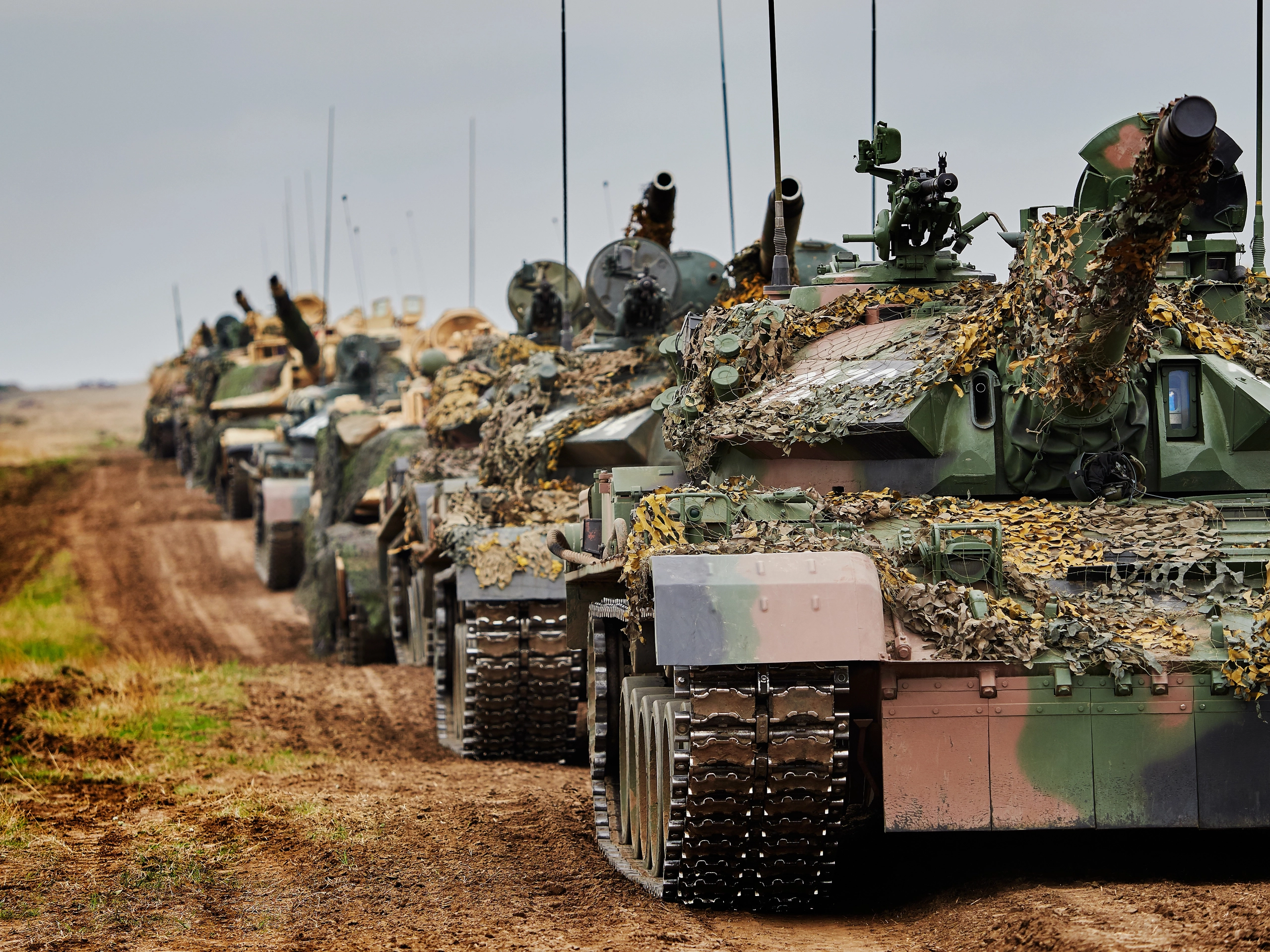
The European Union is preparing a plan to move troops, weapons, and supplies across the continent faster in case of a conflict with Russia.
The European Commission is set to unveil its proposal on Nov. 19, focusing on what officials call “military mobility” – the ability to transport soldiers, ammunition, and equipment quickly and without bureaucratic delays.
JOIN US ON TELEGRAM
Follow our coverage of the war on the @Kyivpost_official.
The document, obtained by RMF FM, includes both new legislative proposals and an update on ongoing projects.
Toward a ‘military Schengen’
Officials in Brussels describe the effort as a kind of “military Schengen,” echoing the system that allows Europeans to travel freely without border checks.
The idea is to create a zone where military convoys can move across borders just as easily – supported by harmonized regulations, upgraded roads and railways, and a network of military-ready corridors, airports, and seaports.
Currently, many European bridges and tunnels cannot handle heavy tanks, and complicated paperwork can delay troop movements for days.
“Transporting tanks from the West to the Eastern Flank could result in them getting stuck in tunnels or waiting for transit permits,” said Dariusz Joński, a member of the European Parliament’s Defense Committee.
Fixing bottlenecks and bureaucracy
The European Commission’s plan aims to remove such obstacles by reinforcing bridges, expanding rail capacity, and improving coordination among member states.
Brussels also wants to digitize customs logistics and set up an “emergency framework” for urgent military transport.

A System Under Fire: WHO’s Ukraine Chief on How Healthcare Has Held On
Another proposal would create a “solidarity fleet” – a pool of specialized railcars and locomotives available for rapid military use across Europe.
In addition, the EU is expected to propose new security measures to protect critical transport routes from sabotage or cyberattacks.
Europe acts as Washington wavers
The push for military readiness comes amid uncertainty about the US commitment to NATO’s eastern flank.
In Washington, Trump administration nominee Austin Dahmer, tapped to lead the Pentagon’s strategy office, recently acknowledged under oath that “Russia remains a security threat to the United States.”
Dahmer’s admission came as the Pentagon faces bipartisan fury over a series of opaque decisions – from quietly pausing aid to Ukraine to withdrawing a US brigade from Romania, a move that startled allies along NATO’s eastern flank.
“Every time Washington hesitates, Moscow tests the line,” said one European diplomat, speaking anonymously with Kyiv Post to discuss sensitive internal assessments. “If the US pulls back even slightly, Russia fills the space immediately.”
Romania, Poland, and the Baltic states see the Pentagon’s mixed signals as potential warning signs of American retrenchment.
“The US may still call Russia a threat,” another European official told reporters in Brussels, “but a threat means little if Washington can’t get its own story straight.”
Coordinating with NATO
European officials emphasize that the plan will be developed in close cooperation with the NATO to avoid duplication.
Poland, in particular, has pushed for ensuring the EU’s efforts remain consistent with NATO’s logistics and defense planning.
You can also highlight the text and press Ctrl + Enter