Hungary on Tuesday secured a five-year liquefied natural gas (LNG) agreement with US energy giant Chevron, though Moscow remains the dominant supplier in Budapest’s energy mix.
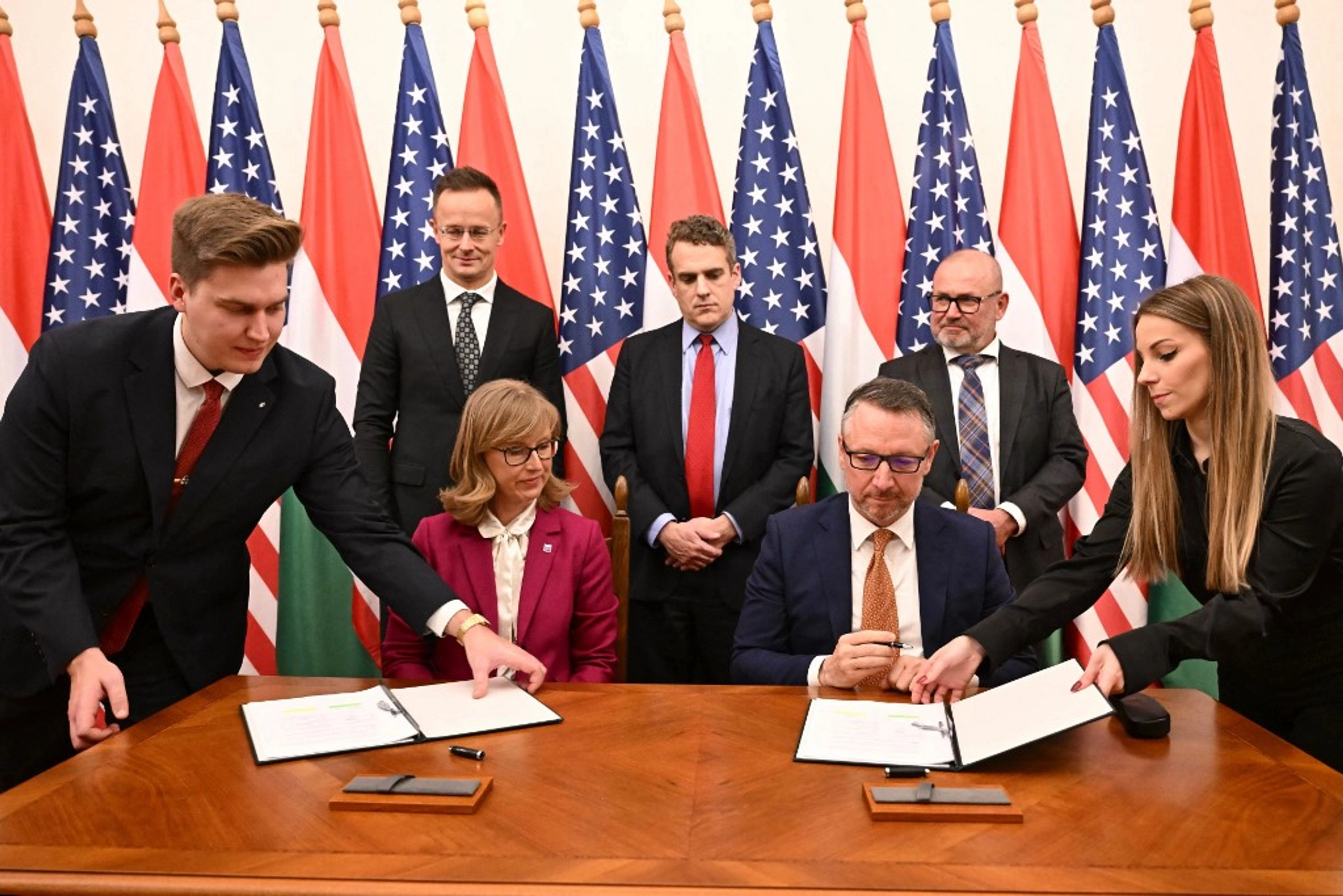
The arrangement, signed between Chevron and Hungary’s state-owned power company MVM, guarantees the annual delivery of 400 million cubic meters of LNG over the next five years, Foreign Minister Péter Szijjártó announced at a Budapest press conference alongside US Deputy Energy Secretary James Danly.
JOIN US ON TELEGRAM
Follow our coverage of the war on the @Kyivpost_official.
Szijjártó framed the deal as an “important milestone,” celebrating what he called a “golden age” of collaboration between the two countries.
Hungary has proved resistant to ongoing pressure from Brussels and Washington to reduce its reliance on Russian energy, but has nonetheless pursued a gradual diversification strategy through new supply contracts.
“We are interested in purchasing energy from as many sources and via as many routes as possible, ensuring the lowest prices,” Szijjártó said in a post on X after the meeting.
The Chevron agreement will cover only a small fraction of Hungary’s gas needs. The Central European country, home to roughly 9.5 million people, consumed around 8.5 billion cubic meters of natural gas last year, with the vast majority sourced from Russia.
The EU has committed to phasing out Russian gas by the end of 2027 as part of a bloc-wide effort to break Moscow’s long-standing energy leverage – an initiative Budapest has consistently opposed.
US Lawmakers Push Bipartisan Bill to Mass-Produce Ukrainian Drones in America
On Dec. 3, Hungary said it would launch an immediate legal challenge against the EU decision to phase out Russian natural gas imports by that date.
Hungary has remained Russia’s closest ally within the EU since its 2022 full-scale invasion of Ukraine. The Washington-based think tank Atlantic Council has labeled Hungary “the biggest outlier” in the EU’s near-unified posture on Russia.
Last month, Prime Minister Viktor Orbán reaffirmed Hungary’s reliance on Moscow’s hydrocarbons during a meeting with Russian President Vladimir Putin, defying the EU’s planned gas import ban.
“We have not given up cooperation [with Russia] in any area, regardless of any external pressure,” Orbán told Putin, reiterating that Russian energy would continue to “form the basis” of Hungary’s supplies.
Hungary also claimed it had secured an indefinite US waiver to keep importing Russian oil and gas after Orbán met US President Donald Trump in Washington last month. A White House official speaking to Kyiv Post, however, said the exemption would last only one year.
Szijjártó took to social media to aggressively counter the claims, calling them “fake news.”
At the time, a White House official said that Budapest had committed to buying US LNG under contracts valued at roughly $600m.
MVM has recently inked contracts with Shell, France’s Engie, and Azerbaijan’s SOCAR. Combined with the Chevron deal, these contracts could provide Hungary with 1.4 billion cubic meters of gas annually from non-Russian suppliers.
Hungarian officials have also expressed interest in procuring new supplies from Central Asia.
Meanwhile, Hungary’s 15-year contract with Gazprom secures 4.5 billion cubic meters per year through 2036, supplemented by additional supply agreements in recent years.
You can also highlight the text and press Ctrl + Enter

Russia Hit by 660-Drone Overnight Barrage Targeting Moscow, Crimea and Key Military Sites