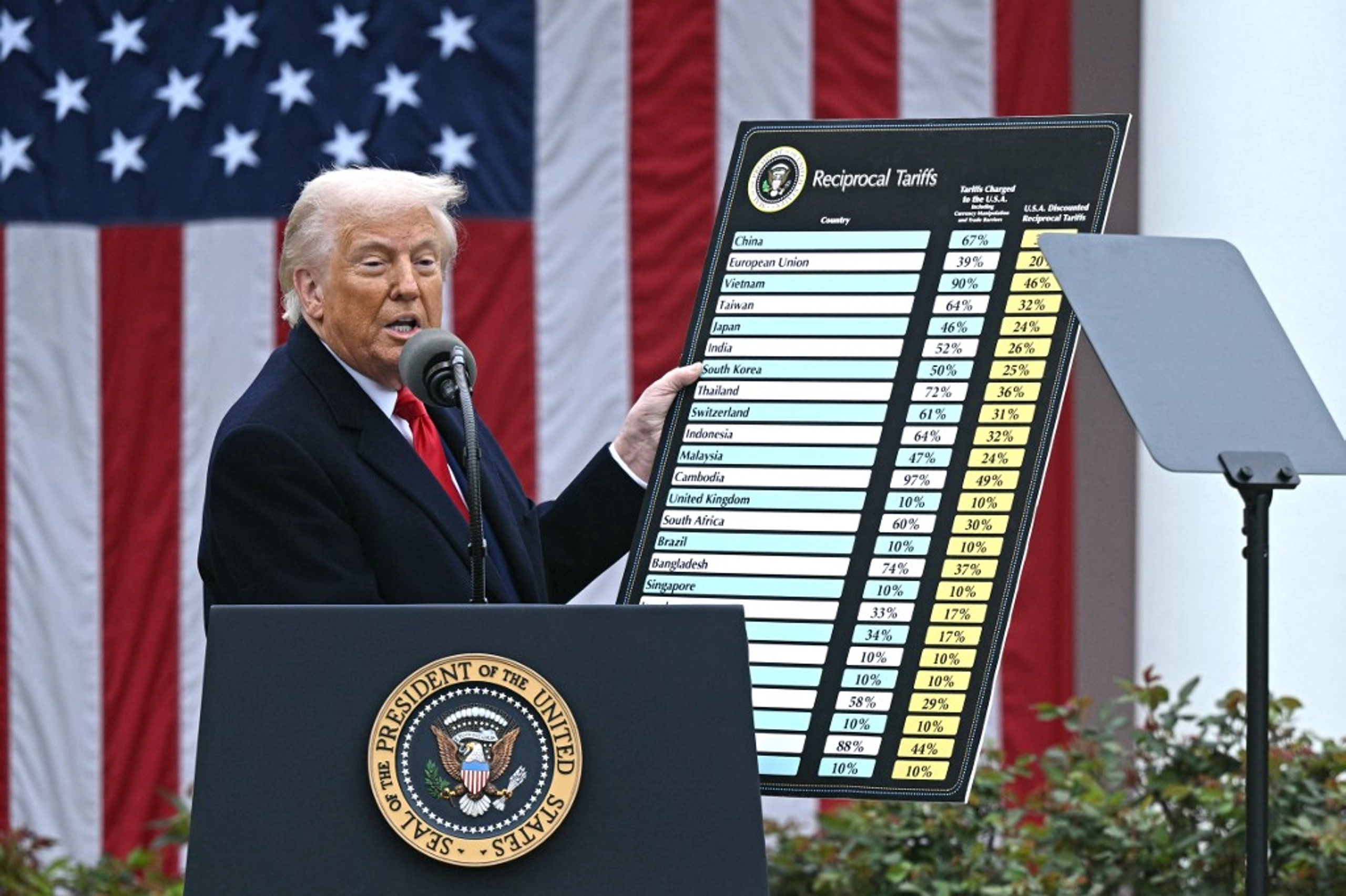
The US president’s decision on Wednesday to impose blanket 20% tariffs on EU goods – as well as a minimum 10% levy on all other imports – will reduce eurozone GDP this year by much less than it will US output, according to several studies released on Thursday.
Moreover, Trump’s protectionist policies and general volatility could prompt radical changes in the global economy that might transform the nature of the EU-US relationship, accelerate multipolarisation, and end the hegemony of the US dollar, analysts said.
JOIN US ON TELEGRAM
Follow our coverage of the war on the @Kyivpost_official.
Thursday’s announcement represents a “massive regime shift” that potentially “spells the end of the American century”, said Sony Kapoor, a professor of geoeconomics at the European University Institute.
“Any sensible, half-prudent company, person, country, or bloc should be thinking of hedging their bets and diversifying their ties across economic, financial, and security dimensions” away from the United States, he said.
In a nod to these future efforts, European Commission President Ursula von der Leyen said on Thursday that the EU will seek to “build bridges” with other nations that “care about fair and rules-based trade”.
The remarks came as Deutsche Bank (Trump’s longtime lender) on Thursday cut its growth forecast for the euro area this year from 0.8% to 0.25-0.50%, while slashing its expected US growth figure from 2.2% to 1%.

Italy Backs Alexander Stubb as EU Envoy for Ukraine-Russia Peace Talks
The Conference Board, a US-based think tank, similarly estimated that Trump’s policies could reduce the EU’s GDP by 0.2 percentage points this year, well below the hit to US GDP of 1.2 percentage points.
Echoing these assessments, Kapoor said the new duties would likely be “bad but not life-threatening” for the European economy.
The tariffs increase the risk of a eurozone recession primarily because the bloc is already suffering from a litany of challenges including high energy prices, weak demand, and fierce competition from Chinese exporters, he said.
“Is it good news for the global economy, for the eurozone economy, for India, or China, or for anybody else? Absolutely not. Does it risk pushing the world into the next Great Depression? Almost certainly not. Does it increase the risk of a eurozone recession? Yes, but that’s mostly because Europe hasn’t been in great shape.”
The divergent fortunes of the US and EU were also reflected in stock market movements on Thursday.
The S&P 500, which tracks leading US firms, was down 4.10% as of 9pm CET, while the STOXX Europe 600, a broad measure of European equities, had fallen just 2.57%. The S&P has slid 7.33% since the start of this year while the STOXX has risen 2.44%.
Impact on US and China tiesTrump’s policies could also lead to a fundamental shift in the nature of the EU-US relationship, analysts said.
Since returning to the White House in January, Trump has repeatedly condemned the EU’s “absolutely brutal” trade surplus in goods with the US, questioned Washington’s commitment to European security, and threatened to annex Greenland, the mineral-rich Arctic island controlled by Denmark.
“We are moving to a world where the transatlantic alliance in the future will not be the same as the alliance that came before the Trump administration,” said Mujtaba Rahman, managing director for Europe at the Eurasia Group.
Rahman added that Trump has already inflicted significant “damage” to EU-US ties at the security, trade and political levels. “Fundamentally, the two sides are moving towards a new equilibrium,” he said.
The tariffs’ impact on the EU-China ties, however, is much less clear-cut.
Some analysts agreed with von der Leyen’s warning on Thursday that the new US duties could lead to China “dumping” billions of euros’ worth of goods onto the EU market.
China’s global trade surplus hit a record $1 trillion last year, driven in large part by massive state subsidisation of manufacturers of green technologies including solar panels, electric vehicles, batteries, and wind turbines.
The EU’s trade deficit in goods with Beijing also rose from €291 billion to €304.5 billion from 2023 to 2024.
“I’m very concerned about China’s huge trade surplus in manufactured goods now bouncing off the US and being rerouted to the large remaining market that’s open, which is Europe,” said Sander Tordoir, chief economist at the Centre for European Reform.
However, Tordoir noted that future Chinese dumping – coupled with a potential “massive” devaluation of the renminbi and weak European demand – suggest that “disinflationary pressures are going to outweigh the inflationary pressures” in future.
His analysis was echoed by Carsten Brzeski, head of macro at ING Research, who noted that China and other countries could seek to cut prices to boost exports to Europe.
“As counterintuitive as it might sound, in the longer run, a fully fledged trade war is likely to be disinflationary for Europe,” Brzeski said.
Corroborating this assessment, Deutsche Bank forecast no change to its inflation forecasts of 2.2% and 1.9% for the eurozone in 2025 and 2026. However, it upwardly revised its prediction for US inflation this year from 2.7% to 4%.
De-dollarisation?Analysts also said that investors’ concerns over Trump’s policies and general unpredictability could cause the dollar to lose its status as the global reserve currency, which has allowed the US to borrow at exceedingly low rates since the end of the Second World War.
Underscoring these fears, the dollar has fallen 5.93% against a basket of other currencies since the start of this year. The euro also rose 1.23% against the dollar on Thursday to reach $1.10 as of 9pm CET.
“There are a number of factors that contribute to the dollar’s dominance in the global financial system, including the rule of law and regulatory predictability,” said Rahman. “To the extent that those things are being actively eroded by the administration, this does, of course, create risks for the long-term hegemony of the dollar.”
Tordoir agreed that “there may be pressure” on the dollar in future but stressed that the US is unlikely to lose its “exorbitant privilege” of controlling the world’s reserve currency in the near future.
“It’s a real scenario,” he said. “I don’t think it’s going to happen overnight.”
See the original here.
You can also highlight the text and press Ctrl + Enter