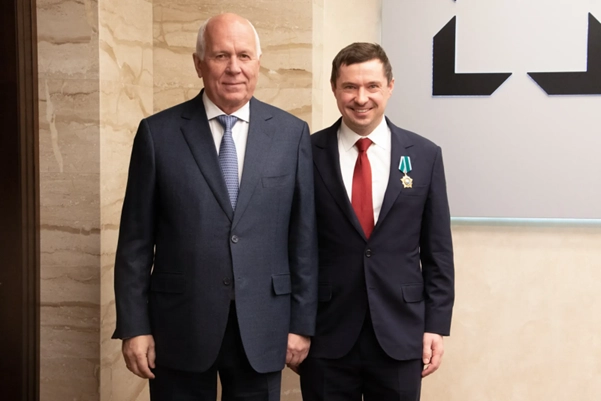
Two high-ranking Russian executives at the heart of Moscow’s defense industry quietly signed a $2.6 million contract with a Washington, DC law firm in March – aiming to lift US sanctions placed on them for their roles in Russia’s war in Ukraine.
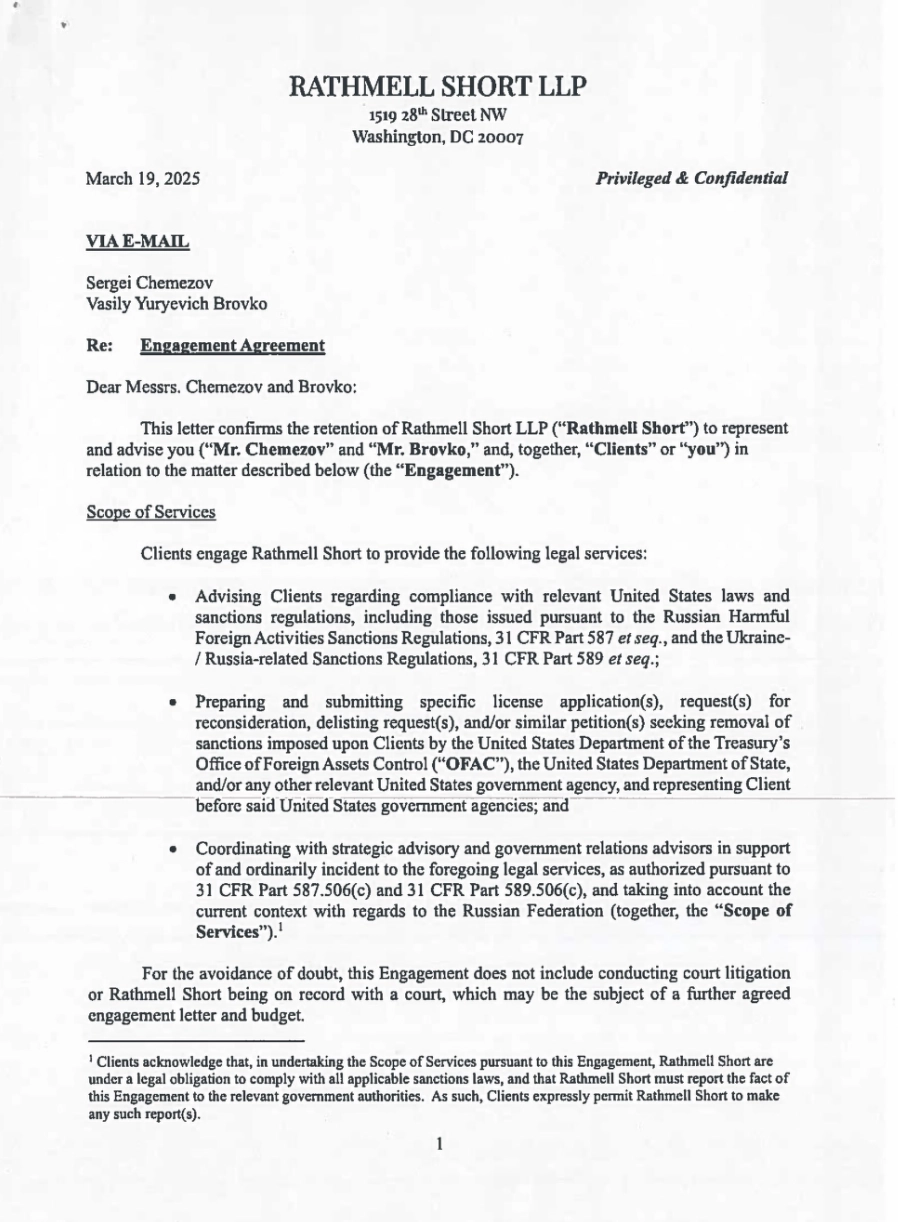
The firm Rathmell Short LLP agreed to represent Sergei Chemezov and Vasily Brovko, both senior leaders of Rostec, Russia’s state-owned military-industrial conglomerate.
JOIN US ON TELEGRAM
Follow our coverage of the war on the @Kyivpost_official.

Sergei Chemezov, a former KGB officer and longtime ally of Russian President Vladimir Putin, has been the CEO of Rostec since 2007 and is widely considered to be among the Kremlin’s most influential businessmen.
Brovko, a younger political operative, serves as Director for Communications, Analytics, and Strategic Research at Rostec, overseeing its IT systems and managing the company’s PR operations – including media strategy for Chemezov.
Ukraine War: Should Europe Mediate?
The new contract outlines a legal strategy to challenge US sanctions, engage directly with US government agencies, and coordinate with a domestic lobbying firm, according to a newly disclosed document filed under the US Foreign Agents Registration Act (FARA). While technically permitted under current sanctions rules, links like these have in the past raised red flags among legal and policy experts.
Both Chemezov and Brovko are currently listed on US sanctions rosters for materially supporting the Russian government’s military actions and political interference in Ukraine, including the 2014 annexation of Crimea and the ongoing full-scale invasion.
Legal – but politically loaded
The FARA filing, dated March 20, discloses the engagement between Rathmell Short LLP and the sanctioned executives. Under the agreement, the law firm will:
- Advise Chemezov and Brovko on US sanctions law.
- Prepare and file petitions for removal from OFAC’s Specially Designated Nationals (SDN) list.
- Submit specific license applications to the US Treasury’s Office of Foreign Assets Control (OFAC).
- Communicate directly with the US Department of State, OFAC, and any other relevant US government agency on the clients’
- Coordinate closely with a domestic lobbying firm – named in the filing as Sonoran Policy Group but doing business as Stryk Global Diplomacy – to support the legal services.
While OFAC rules permit sanctioned individuals to receive certain legal services, including representation for attempts to delist them, the scope and structure of these types of deals raise important questions related to sanctions compliance and national security.
US lawyers are permitted to represent sanctioned individuals in delisting petitions and related legal matters, but must be vigilant about how that representation is structured – especially when it involves communications with government officials or coordination with lobbyists, according to a 2024 legal analysis published by Global Investigations Review (GIR).
“These issues can be particularly difficult to navigate when there are sudden political shifts or unforeseen international crises,” GIR analysts wrote. Attorneys must ensure that legal work does not veer into impermissible influence-peddling or advocacy, particularly in politically sensitive cases.
“For example, after Russia annexed Crimea in 2014, the United States instituted a sanctions regime on Russia, many US law firms continued to represent Russian nationals (including Russian oligarchs) and operate offices in Russia,” experts said.
The situation changed after the Kremlin launched its full-scale invasion. “But when Russia invaded Ukraine in February 2022, the international outrage caused an unprecedented number of multinational law firms to shutter offices in Moscow, disassociate from Russian banking clients, and refuse to take on new Russian clients associated with the Russian economy or regime.”
A sanctions “backdoor?”
The FARA filing also includes a standard clause noting that the contract is not undertaken at the request or direction of a foreign government – a typical statement for individuals acting on their own behalf. However, given the clients’ roles in Rostec and its deep ties the Russian state, it raises broader questions about possible geopolitical implications.
Rostec is Russia’s sprawling state-owned defense and technology conglomerate, that controls over 700 companies involved in weapons manufacturing, cybersecurity, aviation, and more, according to an op-ed authored by Chemzov in BRICS magazine. The corporation plays a central role in supplying the Kremlin’s war machine – including the production of missiles, drones, and military-grade optics – and the company’s strategic importance to the Russian military makes any association with it, especially by Western legal or lobbying firms, politically risky.
US and EU sanctions have repeatedly targeted Rostec and its affiliates, citing their direct contribution to Russian military campaigns in Ukraine, Syria, and other war zones.
Rathmell Short LLP’s role includes not only legal representation before OFAC but also “coordination with the US lobbying firm, Stryk Global Diplomacy, in support of and ordinarily incident to the legal services provided.” While this phrasing is consistent with what is permitted under FARA, it highlights how sanctioned individuals may legally engage lobbying firms in tandem with legal counsel – so long as the work remains incident to the legal strategy.
The line between legal representation and lobbying can be murky, especially when law firms facilitate or coordinate outreach to policymakers on behalf of clients tied to foreign regimes, according to GIR. Even lawful lobbying, in these contexts, may carry reputational risk and unintended political consequences.
Rathmell Short LLP did not immediately respond to a request for comment by Kyiv Post. Stryk Global Diplomacy could also not be reached and the contact information on its apparent website appears non-functional.
Power for sale
The deal with Rathmell Short LLP is no guarantee that the Rostec execs will succeed in clearing their names. OFAC has wide discretion over delisting decisions and considers a range of factors, including evidence of changed behavior and risk to US national security. Still, the effort reflects a long-game approach by powerful Russian figures who understand how to manipulate the American system to maintain their positions of power and influence.
US law permits sanctioned individuals to pursue delisting campaigns, but attorneys must remain cognizant of the broader political implications and ethical considerations, legal experts cited by GIR wrote. Cases involving prominent defense-linked figures from adversarial states often entail even more complexities that extend beyond legal arguments.
Chemezov and Brovko are emblematic of a broader phenomenon: elite Russian figures sanctioned by Western governments still seeking to undermine restrictions through US legal and political channels.
Since taking office for his second term in January, US President Donald Trump has publicly repeated Kremlin talking points, threatened to cut military aid and intelligence sharing with Kyiv, and imposed new tariffs on NATO allies while leaving Russia untouched by new sanctions.
Billed as the best way to cripple the Kremlin’s war machine, thousands of sanctions have already been levied against Russia – but issuing more sanctions could be what finally motivates Putin to leave Ukraine, many have argued.
Despite Trump’s recent public warnings that Putin was “playing with fire” for escalating attacks on Ukraine and has just “two weeks” to negotiate peace, no concrete consequences – or additional support – have so far followed. Ukrainian President Volodymyr Zelensky says the Kremlin is just “trying to buy time” to ramp up its forces for a large offensive later this year.
The ability of Chemezov and Brovko, two sanctioned Rostec officials, to liaise with a top American law firm shows how elite connections can still afford access to Washington – and potentially even enable economic rehabilitation for Russia – just by naming the right price.
You can also highlight the text and press Ctrl + Enter